Girdle of Venus in Palmistry: Can Hands Reveal Sexual Preferences?
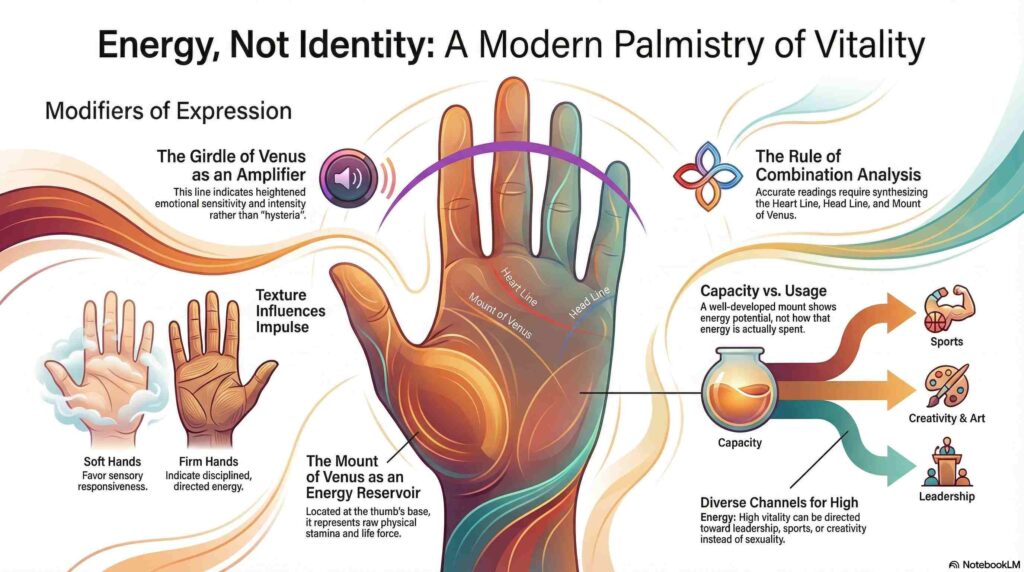
Palmistry is often misunderstood when sensitive subjects like sexuality are discussed. Many people expect direct conclusions from a single line on the palm. However, real palm reading never works through isolated signs. Every indication must be understood in context.
In this article, we will look at one specific feature — the Girdle of Venus — and explore how palmistry may indicate emotional intensity and possible sexual tendencies, while also understanding its limitations.
This discussion is intentionally limited to one aspect only, because no responsible palm reading should ever judge a person based on a single marking.
Palmistry and Sexual Preferences: The Correct Approach
Before discussing the Girdle of Venus, an important principle must be clear:
Sexual nature cannot be judged from one line alone.
A proper palm reading requires an overall assessment, including:
- Shape of the hand
- Size and proportion of the palm
- Structure and flexibility of the hand
- Texture of the skin (soft, hard, harsh, slabby)
- Thin or bony versus padded hands
- Development of mounts, especially the Mount of Venus
Palmistry works through combination analysis, not isolated symbolism.
When we examine sexuality or emotional expression, we are essentially studying how energy manifests in a person’s life.
The Mount of Venus: Energy Before Sexuality
The Mount of Venus represents vitality, stamina, life force, and emotional warmth.
A well-padded or fleshy Mount of Venus may indicate:
- Strong physical energy
- Intense desires
- High emotional responsiveness
- Passionate temperament
But this does not automatically mean heightened sexual behavior.
The key idea is simple:
The mount shows energy — not how that energy is used.
A person with high vitality may channel energy into:
- Professional ambition
- Creative work
- Physical activity
- Emotional relationships
- Or sexuality
Some individuals may focus most of their energy on sensual experiences, while others direct the same intensity toward career or creative pursuits. Palmistry observes potential, not moral judgment.
What Is the Girdle of Venus?
The Girdle of Venus is a curved line appearing above the Heart Line, often running parallel to it. It may sometimes look like a partial or fragmented arc.
Traditionally, older palmists associated this marking with emotional excess and even used terms like hysteria. Such interpretations came from earlier psychological language and should be understood in historical context rather than literal diagnosis.
In modern reasoning-based palmistry, the Girdle of Venus is better understood as a sign of:
- Emotional hypersensitivity
- Heightened reactions
- Psychological intensity
- Strong imagination
Emotional Hyperactivity and Sensitivity
Individuals with a clear Girdle of Venus may experience emotions more intensely than others.
This heightened sensitivity can appear as:
- Being emotionally reactive
- Feeling deeply affected by surroundings
- Rapid emotional highs and lows
- Hyper-awareness of relationships
Because emotions and attraction are closely linked, this sensitivity can sometimes influence romantic or sexual expression. However, it is incorrect to assume that sexuality becomes the central focus of life for every person with this line.
Again, context matters.
Unrealistic Fantasies and Creative Imagination
One of the most interesting aspects of the Girdle of Venus is its connection with imagination.
This line is often linked with:
- Strong fantasy life
- Creative visualization
- Dramatic emotional expression
- Ability to portray complex feelings
Such traits can be highly beneficial in professions requiring emotional depth, including:
- Acting
- Filmmaking
- Photography
- Storytelling
- Artistic performance
A person capable of imagining intense emotional scenarios may portray them more convincingly. In this sense, the Girdle of Venus can become a creative advantage rather than a psychological weakness.
Does Everyone Need a Girdle of Venus?
No.
Many successful and emotionally balanced individuals do not possess this marking at all.
The absence of the Girdle of Venus does not indicate emotional limitation. Likewise, its presence does not guarantee emotional instability.
Palmistry teaches that:
- Every sign has strengths.
- Every sign has challenges.
The Girdle of Venus may enhance emotional complexity, but it can also create unnecessary internal tension or complications in personal relationships if not balanced by other stabilizing signs.
Why One Line Is Never Enough
When discussing sexuality or emotional tendencies, a palmist must evaluate:
- Head Line stability (decision-making control)
- Heart Line quality (emotional balance)
- Mount development
- Overall hand structure
- Texture and firmness of the palm
Only through synthesis can meaningful interpretation emerge.
Looking at a single line is similar to judging a person’s personality from one sentence — incomplete and potentially misleading.
Final Understanding
The Girdle of Venus does not define sexuality. It indicates heightened emotional energy.
What a person does with that energy depends on:
- Personality
- Environment
- Profession
- Life priorities
- Overall hand structure
Some may express it through sensuality.
Others through creativity or professional dedication.
Palmistry, when practiced responsibly, does not label people — it studies patterns of energy and expression.
Every marking on the hand carries both potential benefits and possible challenges. The Girdle of Venus is simply one example of how emotional intensity can shape human experience in different ways.
Not necessarily. It indicates heightened emotional sensitivity and energy. How that energy is expressed depends on the overall hand structure and personality.
Palmistry can indicate emotional intensity, vitality, and desire patterns, but it cannot define a person’s orientation or label their sexuality. A full hand analysis is required.
No line is purely good or bad. The Girdle of Venus can enhance creativity and emotional depth but may also create emotional instability if not balanced.
Absence of the line does not mean emotional weakness. Many emotionally balanced and successful individuals do not have it.